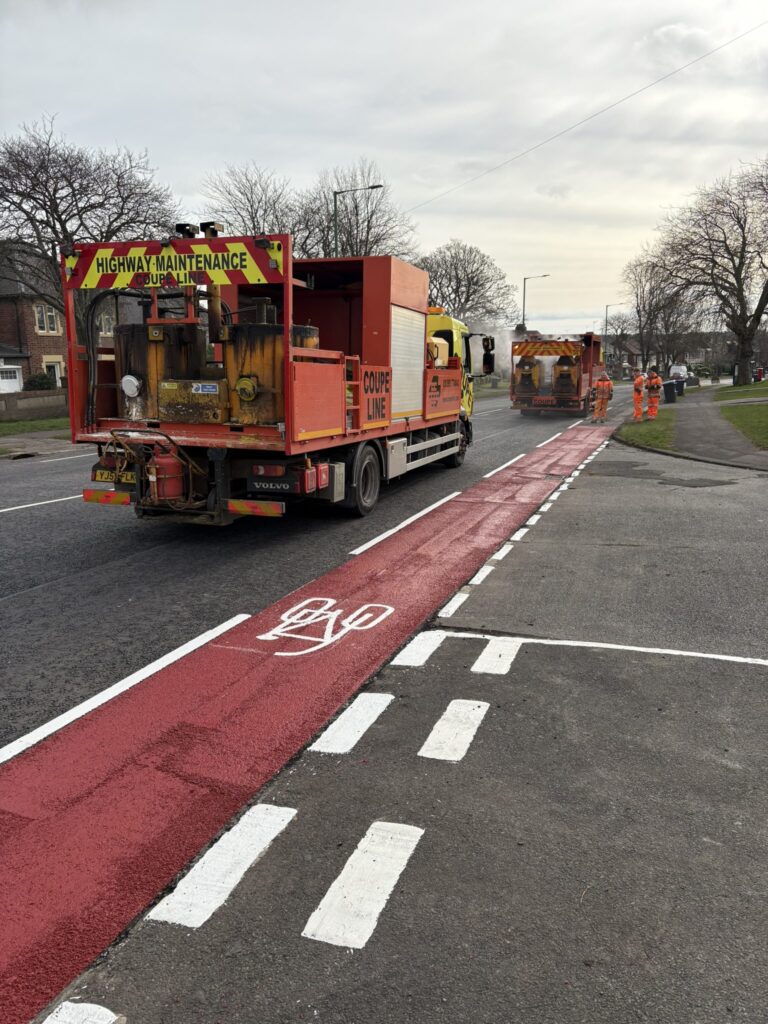
High-friction surfacing is used wherever drivers or cyclists need extra grip to stop or turn safely, especially in wet conditions. In Scotland, that typically means approaches to junctions and crossings, tight bends, steep gradients, roundabouts and high‑stress braking zones. The treatment adds a thin layer of exceptionally hard aggregate bonded to the carriageway, raising skid resistance and shortening stopping distances. Used selectively, it targets risk without the cost and carbon of full resurfacing.
High-friction surfacing in brief
High friction surfacing, often called anti-skid surfacing, uses a resin binder to bond a premium calcined bauxite aggregate to the road. The aggregate retains a sharp microtexture under traffic, so tyres can key into the surface even when the road is wet. The result is improved skid resistance where drivers frequently brake, corner or queue. Systems are typically applied as a thin treatment, with tight control over preparation, binder spread rate, aggregate size and cure times to achieve durable performance.
Two application approaches are common. Cold‑applied resin systems offer precise control and are suited to many road types, including urban sites with complex geometry. Hot‑applied alternatives can speed installation on prepared substrates. The right choice depends on traffic patterns, temperature windows, required cure time and substrate condition. What matters most is an approved system, correct surface preparation and experienced installers.

Where treatment changes outcomes
The biggest safety gains come at specific locations where loss of grip leads to disproportionate harm. On Scottish roads, the priorities are familiar to highway engineers and road safety teams:
- Approaches to junctions, roundabouts and traffic signals
- Pedestrian and cycle crossings, including school approaches
- Tight bends, hairpins and off‑camber curves
- Steep gradients, stop ramps and slip‑road tapers
- Braking and queuing zones near tunnels, bridges and merge points
These sites concentrate heavy braking, turning and lane changes. When rain lifts detritus and bitumen to the surface, microtexture matters. On a rural single-carriageway with a sharp bend, for example, high-friction surfacing can counter polishing in the wheel tracks and help drivers maintain their line. In towns and cities, colour‑contrasted high-friction surfaces at crossings and cycle-priority areas make intent clearer while increasing grip where vulnerable users mix with traffic.
Scottish topography magnifies these needs. Coastal approaches with steep streets, hillside settlements with switchbacks and trunk‑road bends that transition quickly from open moor to tree shade all produce sudden changes in visibility and grip. Shorter stopping distances here are not theoretical; they change collision severity.
Why these sites become high risk
Risk concentrates where drivers must change speed or direction under pressure. Braking compresses tyre tread blocks, which reduces the water path and allows a thin film to persist unless a strong microtexture is present. Repeated wheel tracking polishes standard surfacing at the approach to stop lines, roundabouts and crossings. Curvature and adverse camber increase lateral demand on tyres, so any drop in texture, or contamination from leaves and mud, reduces the margin for error. At conflict points where road users mix, such as pedestrian crossings and cycle entries to junctions, acceptable stopping distances are shorter. High-friction surfacing addresses these mechanisms by maintaining the asperities that tyres need to interlock, even under heavy shear.
Scottish weather and road context
Scotland’s rain patterns, freeze‑thaw cycles and winter maintenance all affect skid resistance. Frequent wetting reduces natural drying of the macrotexture, so any binder flush or contamination persists longer. Freeze‑thaw can open microcracks that trap fines and reduce drainage at the surface. Gritting and snowplough operations keep networks moving, but turning movements over treated areas, especially at mini‑roundabouts, can accelerate wear if the wrong system or grading is chosen.
Rural carriageways also collect debris from verges, forestry and agriculture. Mud and leaf mulch reduce effective texture at bends, cattle grids and farm junctions, so targeted high-friction surfacing can help maintain control until routine sweeping restores the baseline.
How sites are identified and prioritised
Authorities in Scotland typically combine collision analysis, safety audit findings and measured skid resistance to select schemes. Network engineers look at patterns, not one‑offs, and focus on changeable geometry or braking demand. Screening tools, such as SCRIM surveys and local risk registers, highlight candidates. A site inspection then confirms the geometry, drainage, contamination sources, and practical constraints such as drainage ironwork and utility covers. For an overview of how projects are delivered on the public network, see our work with Highways and Local Authorities.
A short list of common decision factors includes:
- Approach speed and braking demand
- Curve radius, camber and gradient
- Wet‑skid collision history and near‑miss reports
- Existing texture depth and measured skid resistance
- Turning and queuing stress from layout or signal timing
When treatment is selected, limits should extend beyond the immediate stop line or apex to capture the full braking and turning envelope. Good detailing around covers, detector loops and studs preserves both function and durability.
Coloured and specialist applications
The same high-friction principles support coloured surfacing for legibility. Red or green resin‑bonded zones on cycle approaches, bus‑only gates and pedestrian build‑outs guide users and reinforce priority. On coastal promenades and shared‑use links, a colour‑contrasted high-friction finish separates movement streams and maintains grip where salt spray and algae can otherwise make surfaces slick. In car parks and public realm, short runs at ramps and exits help drivers control speed as they join live traffic.
Lifespan, maintenance and limitations
Correctly specified and installed high-friction surfacing is durable, but it is not indestructible. Lifespan depends on traffic loading, turning stress, contamination and winter operations. Straight approaches to signals often last longer than tight mini‑roundabouts, where tyres scrub aggressively. Snowplough blades and heavy plant can damage edges if detailing is poor.
Maintenance is straightforward. Routine inspections check for aggregate loss, edge fretting and binder exposure. Localised patch repairs can restore performance without lifting whole areas, provided compatible systems are used. Good housekeeping matters too. Sweeping, drain upkeep, and spill response maintain surface texture, while timely remarking of lines ensures the whole site communicates clearly.
Limitations are mostly about fit. High-friction surfacing is not a cure for standing water, structural failure, or poor geometry. Drainage defects, potholes and surface ravelling should be fixed before treatment so the binder keys into a sound, dry, dust‑free substrate. Where longer lengths have lost texture but remain structurally sound, retexturing the road surface can restore grip without full resurfacing.
Choosing materials and installers in Scotland
Performance starts with specification. Approved systems using premium calcined bauxite with a high Polished Stone Value are the norm for public roads. Selection between hot‑ and cold‑applied binders should account for temperature windows, cure times and traffic management constraints. Surface preparation, including planing or shotblasting where needed, is critical to bond strength. So is primer selection for concrete or older asphalt.
Experienced, certified installers will verify substrate moisture, confirm spread rates and prove bond through pull‑off testing where required. For an outline of installation stages and treatment options, see Coupe’s anti-skid surfaces guide, which explains materials, applications and finish expectations in more detail.
Plan safer surfacing on Scottish roads
If you are scoping a junction, bend or crossing that shows wet‑skid risk, target the braking and turning envelope first, then choose a certified system that fits the site, season and traffic. The right high-friction treatment, in the right place, delivers rapid safety gains with minimal disruption.
Frequently Asked Questions:
Where is high-friction surfacing most effective in Scotland?
The most effective sites are approaches to junctions and roundabouts, pedestrian and cycle crossings, tight bends and off‑camber curves, steep hills, and braking or queuing zones near tunnels, bridges and merges. These are the locations where heavy braking and turning happen most often in wet conditions.
How long does high-friction surfacing last at busy junctions?
Service life varies with traffic and turning stress. Straight approaches to signals can last several years, while tight mini‑roundabouts wear faster because tyres scrub across the surface. Regular inspections and localised patch repairs help maintain performance over time.
Can anti-skid surfacing be installed during winter in Scotland?
Yes, but the substrate must be sound, clean and dry, and the system must be applied within its temperature and humidity limits. Cold‑applied systems often suit cooler weather, although cure times and traffic management may need to be adjusted. In some cases, it is more efficient to schedule installation during a milder window.
How do you decide the limits of a treatment area?
Engineers consider approach speeds, braking demand, curve radius, gradient, measured skid resistance and any wet‑skid collision history. The treatment normally extends beyond the stop line or bend apex to cover the full braking and turning envelope.
What preparation is needed before installation?
Defects such as potholes and ravelling are repaired first. The surface is then cleaned, dried and, where required, planed or shotblasted to create a sound key. Primers are used on suitable substrates. Detailing around ironwork, detector loops and studs protects those features and the bond.
Do you offer coloured high-friction surfacing for crossings and cycle routes?
Yes. Coloured resin‑bonded bauxite can improve site legibility at crossings, cycle-priority areas and bus gates while providing the same high-friction performance.