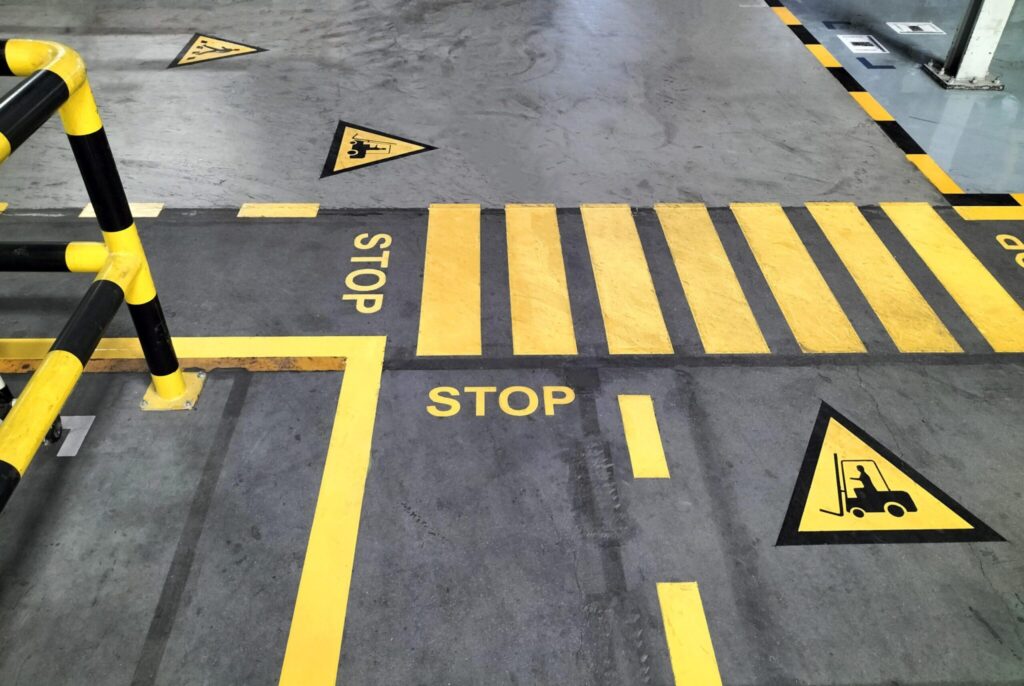
Warehouse line marking organises space, separates people from the plant and reduces collisions. In Scotland, the same UK guidance applies, but busy sites also need markings that withstand heavy use, rigorous cleaning, and colder ambient conditions in loading areas. This guide explains how to plan safer routes for forklifts, vehicles and pedestrians, choose materials that last and deliver the work with minimal downtime.
Why warehouse line marking matters
Clear floor marking sets the rules of movement in a way that is always visible. It shows where to walk, where to drive, where to load and where not to go. The result is fewer near misses, faster picks and fewer blockages at pinch points. Markings also support compliance with UK workplace safety law by making control measures obvious and consistent.
Excellent layouts do three things at once. They separate conflicting movements, they make intent unambiguous, and they work with the site’s workflow rather than against it. That combination is what keeps forklifts, tugs, HGVs and people moving safely through the same building.
Principles for safer mixed-traffic routes
Mixed traffic is normal in distribution centres and storage facilities. The safest schemes apply a small set of principles consistently across the floor plan.
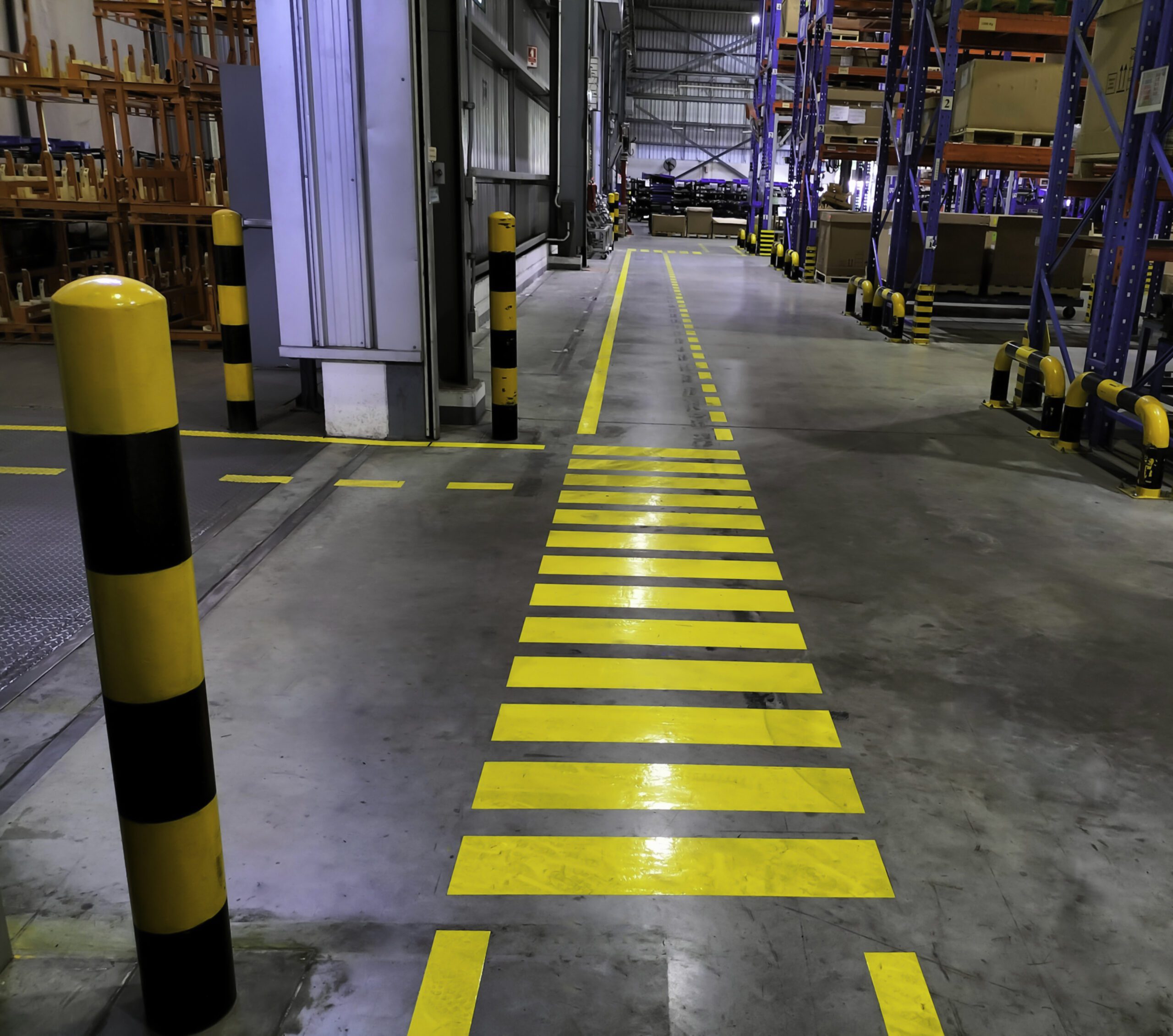
Start with segregation. Create dedicated pedestrian walkways with continuous lines and right-angle crossing points across forklift or vehicle routes. In busy areas, such as end-of-aisle zones and near shutter doors, avoid shared space wherever possible.
Minimise conflict at racking ends. Forklifts pivot, accelerate and brake here, so lane control and visibility matter. Stop lines, chevrons, or hatch markings help with turning and reserve room for swing. One-way systems inside aisles reduce head-on risk and allow narrower passing clearances without compromising safety.
Protect blind spots created by racking, pillars and doorways. Hold lines in front of pedestrian doors opening into vehicle paths, and use high-contrast hatch boxes to preserve sight lines. Keep emergency egress and fire equipment clear, with marked one metre zones, and maintain uncluttered evacuation routes to muster points.
Extend the same thinking to yards and marshalling areas. Separate pedestrian access near level docks, provide waiting zones for drivers and mark reversing boxes and trailer stands clearly.
Common warehouse floor markings and where to use them
Most warehouses share a core set of markings. Pedestrian walkways usually run along walls, beside racking and between work areas, with zebra-style crossings at intersections and across vehicle lanes. Where pedestrians must follow a longer route to stay safe, make that route obvious and continuous.
Forklift and vehicle lanes connect goods in, storage, pick faces and goods out. Directional arrows, centre lines where sight lines are long, and stop lines where control is needed all contribute to smooth movement. Keep turning radii generous where floor space allows.
Loading, transfer and marshalling zones define where pallets, cages and roll containers can be staged. Number or letter these bays to support scanning and WMS instructions. Use no-stacking boxes or maximum stack-height notes where required.
No-go and hazard areas are located around machinery, under lifts, within reach of swing doors, in front of emergency equipment, and beneath mezzanine overhangs. Hatching deters encroachment. Storage aids, such as pallet positions, racking bay IDs, staging grids and order consolidation boxes, speed up picking and reduce disputes over space. Align markings precisely to racking centres and pallet sizes. Safety messages and symbols, for example KEEP CLEAR, ONE WAY, PEDESTRIANS and speed limits, reinforce the system without crowding the floor with posts.
Colours, symbols and contrast
There is no single, legally mandated colour code for warehouse floor markings in the UK. HSE expects risks to be controlled and arrangements to be clear. Many sites follow common practice, often combined with recognised safety sign colours on walls and posts. The key is clarity, contrast and consistency.
Typical, well-understood uses include yellow for general segregation lines and walkways, white for symbols, arrows and numbers, red for fire points, emergency stops and no-go zones, and green for first aid or safe conditions. Black and yellow chevrons suit hazard hatching and keep clear zones. Choose colours that contrast strongly with the floor finish under your lighting. On darker epoxy floors, high build white and bright yellow remain legible after cleaning. On very light floors, consider darker lines or outlining. Use standard symbol sets aligned with ISO 7010 where wall signs accompany floor markings.
Material options and durability under heavy use
Warehouse floors take punishment. Forklifts scuff when turning, pallet trucks scrape, and cleaning regimes add chemical and mechanical wear. The right material depends on traffic, cleaning, expected lifespan and allowable downtime.
A simple way to think about options:
- High build epoxy or polyurethane: durable, chemical resistant, strong adhesion on prepared concrete and epoxy floors, typical cure to light traffic overnight
- MMA resin, methyl methacrylate: very fast cure in colder conditions, excellent wear, distinct odour during install, ideal for tight shutdowns
- UV-cured resins: near instant cure under UV lamp, minimal downtime in confined areas, needs specialist equipment and well-managed access
- Two-pack polyurethane line paint: flexible, good abrasion resistance, shorter return to service than many epoxies
- Industrial floor tapes and preformed shapes: rapid install with minimal disruption, best for temporary layouts or where frequent changes are expected
For the heaviest forklift pivot zones, a higher-build resin system with optional anti-slip aggregate often outlasts thin-film paint. In cold Scottish winters, MMA and some polyaspartic systems help keep programmes on track in unheated loading areas by curing quickly at lower temperatures. Balance performance with odour control, ventilation and the practicalities of working inside a live building.
Surface preparation and line removal
Preparation makes or breaks adhesion. Even the best resin fails early on dusty, polished or oily concrete. Start with mechanical preparation, typically captive shot blasting or diamond grinding, to remove laitance, sealers and contamination, and to create a clean profile for bonding.
Repair joints, chips and spalls so lines sit on a stable, level substrate. Degrease and vacuum thoroughly to control dust. Where new slabs are still drying, moisture testing guides priming choices. Then apply the correct primer matched to both substrate and chosen system. Old or confusing lines should be removed rather than overpainted. Enclosed shot blasting keeps dust down for broad removal, diamond grinding delivers precise removal in tight zones and planing suits thicker thermoplastic lines in external yards.
Planning a layout that fits your operation
A safe scheme mirrors your workflow. Map the process flow between goods-in, racking, pick faces, packing, and dispatch. Count volumes, not just routes, so lane widths and crossing points suit actual traffic. Identify hot spots such as end-of-aisle turns, areas near shutter doors, pedestrian entrances, battery charging areas, narrow corridors, and lift interfaces. Agree on aisle directions and turning policies before you draw lines. A one-way system is cheaper than adding space you do not have.
Check racking geometry and pallet sizes, then design pallet positions and staging grids to fit exactly. Align lines to real centres rather than approximations. Coordinate signage, barriers, and mirrors so that markings and physical aids reinforce the same rules. Validate the draft scheme on the floor with temporary tape before committing to paint or resin. For a view of how a contractor plans and delivers inside live sites, see Coupe’s warehousing and logistics line marking services, which outline structured delivery in high-activity environments.
Minimising disruption during installation
Warehouses often operate long shifts with little room for downtime. Programme design matters as much as material choice. Phase the works by zone to keep critical routes open. Where full closure is unavoidable, schedule overnight or weekend shifts. Use fast-cure materials in high-throughput areas. MMA and UV-cured systems allow near-immediate return to service with the right controls. Brief staff about exclusion zones and coordinate with cleaning so freshly applied lines are not scrubbed before cure. Loading bays can be several degrees colder than internal pick areas, which affects resin behaviour, so keep curing times realistic for the season.
Integrating line marking with industrial flooring
Line marking works best on a sound, well-finished floor. Many operators combine a high-performance industrial coating with a durable marking system for a long-life finish. Where a new epoxy floor is being installed, build the marking scheme into the specification. Colour-code zones in the base system where helpful, then apply high-contrast lines and symbols over the cured coating. Confirm compatibility, use suitable primers and sequence the work so lines go down after the coating reaches full strength. Coupe’s epoxy flooring guidance explains coating options for industrial environments and how coatings integrate with forklift routes, pedestrian walkways and loading areas.
Guidance and compliance context in Scotland
Scottish warehouses follow UK-wide legislation and guidance. Employers must manage risks and provide safe systems of work. HSE’s warehousing and storage guidance describes how segregation, traffic control and housekeeping contribute to safe operation. Floor marking is not prescribed in law in a strict colour-by-colour sense, but it is a practical, widely accepted control that supports risk assessments and traffic management plans. Keep escape routes and access to fire equipment clearly marked and unobstructed, train staff on the meaning during induction and refreshers, and review the plan after significant operational changes.
Maintenance, inspections and lifecycle
Even well-applied lines wear. Abrasion is greatest where trucks pivot and where pallets are dragged, and cleaning can dull contrast over time. Inspect high wear areas monthly and schedule touch-ups before legibility drops. Keep markings clean because dirt reduces contrast long before physical wear does. In very heavy use, thin-film paint may need attention within 12 to 24 months, while higher-build resins can remain serviceable significantly longer. Record incidents and near misses by location and adjust markings, barriers or flows where hotspots persist.
When to change or remove markings
Update markings when routes no longer match the reality on the floor. Before adding new lines, remove obsolete ones in full to avoid mixed messages. Where a complete redesign is needed, schedule removal, preparation and reapplication as a single controlled programme so the building never operates with half a system.
How Coupe Road Markings supports warehouses in Scotland
Designing and delivering a safe, efficient scheme in a live warehouse takes planning, material knowledge and disciplined execution. Coupe Road Markings works across warehousing and logistics, aligning layouts to real workflows and programming works to suit access windows. For an overview of sector experience and delivery approach, see Coupe’s warehousing and logistics line-marking services, which cover planning, materials, and installation in high-activity environments.
If you are comparing options for a combined floor and marking upgrade, refer to Coupe’s epoxy flooring guidance for industrial settings and to how coatings integrate with line marking to create durable, high-contrast routes that withstand forklifts and cleaning.
Useful next steps
- Review your current layout against the principles in this guide. Note hotspots, blind spots and areas where people and plants still mix.
- Decide whether you need a targeted refresh, a staged redesign, or a full replan, along with a new floor finish.
- Shortlist materials based on traffic, cleaning regimen, and allowable downtime. Fast-cure options suit short access windows; high-build resins suit long life in heavy-wear zones.
- Arrange a site survey to validate widths, turning radii and pallet geometry before finalising drawings.
Explore Coupe’s core line marking capability for broader applications across your estate, or discuss a scoped plan for your Scottish facility with the team.
Frequently Asked Questions
Do warehouse floor markings have to follow a specific colour code in the UK?
No. There is no law that mandates exact colours for floor markings. HSE expects risks to be controlled and arrangements to be clear. Many warehouses use common practices, such as yellow for walkways and segregation, red for fire points and no-go zones, and white for symbols and arrows, kept consistent across the site.
Which marking materials work best in cold Scottish loading bays?
Fast-curing systems such as MMA resins and selected UV-cured resins are well-suited to colder, unheated areas because they cure quickly at lower temperatures. Higher-build epoxy or polyurethane systems remain strong options for indoor use. The right choice depends on access windows, odour tolerance, ventilation and traffic levels.
How long do warehouse line markings last under forklift traffic?
It varies by material, traffic and cleaning. Thin-film paints in heavy-pivot zones may need attention within 12 to 24 months. Higher-build resin-based systems with good preparation can last significantly longer before a refresh. Regular cleaning to preserve contrast and timely touch-ups extends usable life.
Can you apply line markings to an epoxy floor?
Yes, provided compatibility and adhesion are managed. Lines should be applied over a fully cured coating with correct surface keying and a primer suited to the coating and line material. This helps prevent delamination and preserves crisp edges in high-traffic areas.
How can downtime be minimised during installation?
Plan works in phases: keep critical routes open and schedule higher-impact zones overnight or at weekends. Use fast-cure systems where appropriate, brief teams on exclusion zones, and coordinate with cleaning so new lines are not scrubbed before cure. Adjust curing expectations for colder loading bays.